
What Is Roadschooling?
A Beginner’s Guide to Learning While Traveling Full-Time
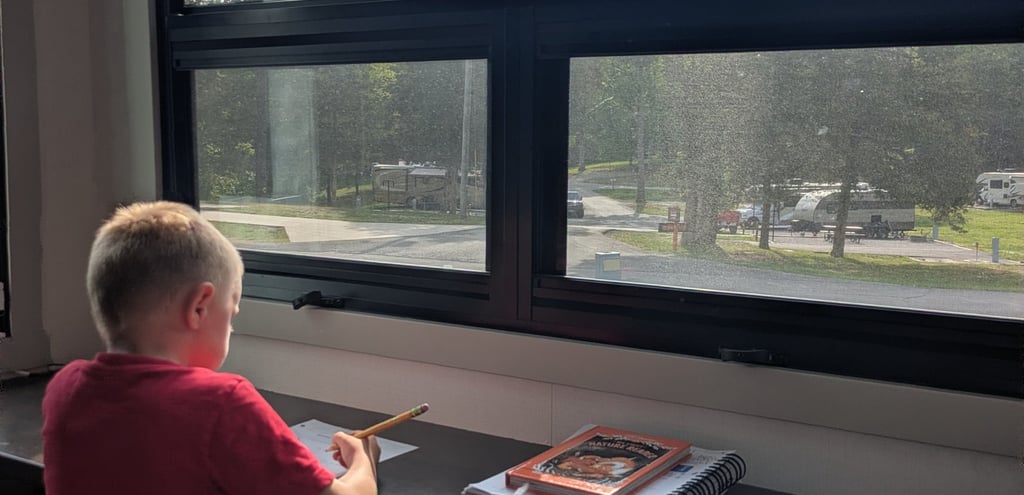
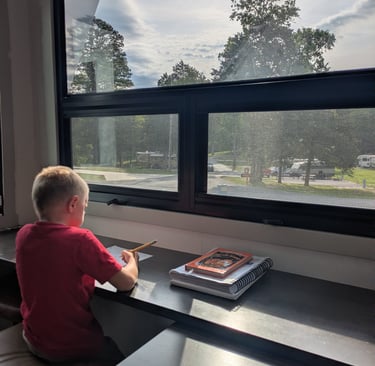
When most people picture school, they imagine desks lined up in rows, backpacks hanging in cubbies, and a classroom that looks the same every single day. But for a growing number of families, education looks very different.
Sometimes it looks like math lessons at a picnic table in the mountains.
Sometimes it looks like reading books beside a campfire.
Sometimes it looks like learning American history while standing at the exact place it happened.
That lifestyle is called roadschooling.
Roadschooling is a form of homeschooling that happens while a family travels regularly or lives on the road full-time and it's a a topic we are questioned about often. Many roadschooling families travel in RVs, vans, buses, or campers, though some slow-travel through Airbnbs or temporary stays. At its core, roadschooling combines education with real-world experiences and adventure.
For our family, roadschooling has become more than just “doing school while traveling.” It has become a completely different way of thinking about learning, family life, freedom, and what childhood can look like.
If you’ve ever wondered what roadschooling actually is, how it works, or whether it’s realistic for your family, this guide will help you understand what life on the road can truly look like.
What Exactly Is Roadschooling?
Roadschooling is homeschooling while traveling. That’s the simplest definition.
Instead of being tied to one home, one town, or one school district, roadschooling families take learning with them wherever they go. The road becomes part of the curriculum.
A trip through Tennessee might become a history lesson about early America. A hike in Colorado becomes a science lesson about ecosystems and wildlife. Visiting a local farmers' market turns into conversations about economics, agriculture, and culture.
We often use what is around us to dictate additional lessons outside of our regular subjects. If there is an orange orchard down the road or a wildlife sanctuary nearby where we are staying, we make it a day trip! We'll supplement additional learning when we get home with videos and researching highlights the kids loved seeing that day!
Roadschooling allows children to experience learning firsthand instead of only reading about it in a textbook.
But one of the biggest misconceptions is that roadschooling means traveling every single day. Most families are not constantly moving. Many stay in one location for weeks or even months at a time. Some travel slowly and intentionally, while others move frequently depending on work schedules, weather, or travel goals. We are often in one area for a month or longer.
There is no single “right” way to roadschool.
Why Families Choose Roadschooling
Every family has a different reason for starting this lifestyle.
Some families want more freedom and flexibility. Others want more time together. Some are frustrated with traditional school schedules or environments. Others simply feel called to explore more of the world while their children are young.
For many families, roadschooling creates opportunities that would be difficult to experience in a traditional lifestyle.
Instead of waiting for one family vacation each year, life itself becomes the adventure.
Children grow up seeing different states, landscapes, cultures, and ways of life. They learn adaptability, communication skills, independence, and problem-solving in ways that are difficult to recreate inside a classroom.
Parents also often discover something unexpected: life slows down.
Without the constant pressure of rushing from activity to activity, many families find themselves reconnecting. Meals become slower. Conversations become deeper. Children spend more time outdoors. Learning feels less forced and more natural.
That doesn’t mean roadschooling is easy all the time. It absolutely comes with challenges. But many families believe the benefits far outweigh the difficulties.
What Does a Typical Roadschool Day Look Like?
One of the most common questions people ask is:
“But how do the kids actually do school?”
The answer is different for every family.
Some roadschooling families follow a structured curriculum every morning. Others lean into a more relaxed or child-led approach. Most families land somewhere in the middle.
A typical roadschool day might include:
Math lessons at the RV table
Reading time before breakfast
Journaling about places visited
Online learning programs
Educational YouTube videos or documentaries
Nature walks and outdoor exploration
Audiobooks during travel days
Hands-on science activities
Visiting museums, landmarks, or historical sites
Quiet reading in hammocks or camping chairs
One of the biggest benefits of roadschooling is flexibility. Learning does not have to happen from 8:00 a.m. to 3:00 p.m. Children can learn in shorter bursts throughout the day. If the weather is beautiful, many families prioritize outdoor exploration and complete formal lessons later.
Travel itself becomes educational.
Kids learn map skills, budgeting, trip planning, geography, weather patterns, mechanics, and problem-solving simply by living this lifestyle.
And surprisingly, many roadschooling families discover that traditional schoolwork often takes far less time than expected. Without classroom transitions, large student groups, and busy schedules, focused learning can often happen efficiently.
Roadschooling Is Not “School on Vacation”
This is where many people misunderstand the lifestyle.
Roadschooling is not a nonstop vacation.
There are still dishes to wash, laundry to do, bills to pay, work schedules to manage, and hard parenting days. There are rainy weeks inside the RV. There are arguments between siblings. There are internet issues and travel delays.
Roadschooling families still experience real life.
The difference is that real life happens in changing places.
The mountains become your backyard one month. The beach becomes your classroom the next.
Children learn that home is less about a physical building and more about the people they are with.
Socialization and Friendships
One of the biggest concerns people have about homeschooling — especially roadschooling — is socialization.
Ironically, many roadschooling children end up meeting more people from different backgrounds than they would in a traditional school environment. We have found many families traveling and can attest to this. Finding community can be the hardest part of any homeschooling journey.
Roadschooling families often connect through:
Campgrounds
Full-time travel groups
Homeschool meetups
National rallies and events
Online communities
Local libraries and parks
Children quickly learn how to introduce themselves, build friendships, and adapt to new social situations.
One beautiful thing about the roadschooling community is how welcoming many families are. Kids often bond quickly because they share similar lifestyles and experiences.
That said, friendships can look different in this lifestyle. Some friendships are brief but meaningful. Others become lifelong connections that families reconnect with across the country.
The Challenges of Roadschooling
Roadschooling is rewarding, but it is not effortless. Living and traveling together full-time requires patience, flexibility, and intentionality.
Some common challenges include:
Limited Space
Living in an RV or camper means everyone shares a smaller environment. There is less personal space and fewer opportunities to “escape” during hard moments.
Changing Routines
Travel days can interrupt schedules and consistency. Parents often have to learn how to balance structure with flexibility.
Internet and Work Balance
Many roadschooling parents work remotely while homeschooling and traveling. Balancing work, parenting, and education can feel overwhelming at times.
Financial Pressure
Traveling full-time can be affordable, but it still requires planning and budgeting. Families must carefully manage fuel costs, campground fees, maintenance, and income.
Decision Fatigue
Where to go next, when to move, what route to take, how long to stay — constant decisions can become mentally exhausting.
Despite these challenges, many families say the lifestyle has strengthened their family relationships and helped them focus on what matters most.
Do You Need an RV to Roadschool?
No. While RV life is the most recognized version of roadschooling, it is not the only option.
Some families:
Travel internationally
Stay in short-term rentals
Use converted vans or buses
House sit across the country
Slow travel seasonally
Roadschooling is less about the vehicle and more about the mindset.
It’s about choosing learning through experiences, flexibility, and exploration.
How to Start Roadschooling
If roadschooling interests you, you do not need to have everything figured out immediately.
Most families start small.
You can begin by:
Taking longer educational trips
Homeschooling while traveling during the summer
Trying weekend “roadschool” adventures
Researching homeschooling laws in your state
Downsizing gradually
Connecting with other traveling families online
One important thing to understand is that roadschooling does not have to look perfect.
Social media often highlights the beautiful sunsets and scenic campsites, but behind those moments are real families figuring things out day by day.
You do not need a luxury RV, a massive budget, or a perfectly organized homeschool room to begin.
Children do not need Pinterest-perfect lessons to learn deeply and meaningfully.
Sometimes the best learning happens through conversations, experiences, mistakes, and curiosity.
What Roadschooling Has Taught Our Family
For our family, roadschooling has changed far more than our address.
It has changed our perspective.
We have learned that children can thrive outside traditional systems. We have learned that family memories are built in ordinary moments. We have learned that slower living often creates a deeper connection.
Our children are learning academics, yes. But they are also learning adaptability, resilience, communication, creativity, and confidence.
They are learning that the world is bigger than one town.
They are learning that life does not have to follow one single path.
And honestly, we are learning right alongside them.
Roadschooling has reminded us that education is not confined to four walls. Learning happens everywhere.
At the campground.
On hiking trails.
In small-town museums.
Around campfires.
At roadside diners.
Inside conversations.
Across thousands of miles together.
Is Roadschooling Right for Your Family?
Roadschooling is not for everyone. It requires sacrifice, flexibility, and a willingness to live differently from most people around you.
But for some families, it opens the door to a completely different kind of life.
A life with more time together.
More experiences.
More adventure.
More freedom.
And perhaps most importantly, more intentionality.
If you’ve been curious about roadschooling, you do not need to have every answer today. Start by asking questions. Learn from other families. Explore what homeschooling could look like for your children.
You may discover that education can happen far beyond the walls of a classroom.
Sometimes the best classroom is the open road.
© 2025 Wandering Rocks, LLC.
All rights reserved.
The Wandering Rocks Family participates in affiliate partnerships that help support our travels and content.
As an Amazon Associate, we earn from qualifying purchases.

